Evaporative Humidifier Water Panel Scaling and Static Pressure Loss
Field measurements from 2016 to 2026 show hard water exceeding 120 ppm reduces Aprilaire Model 35 evaporative panel output by 38 percent within 90 days.
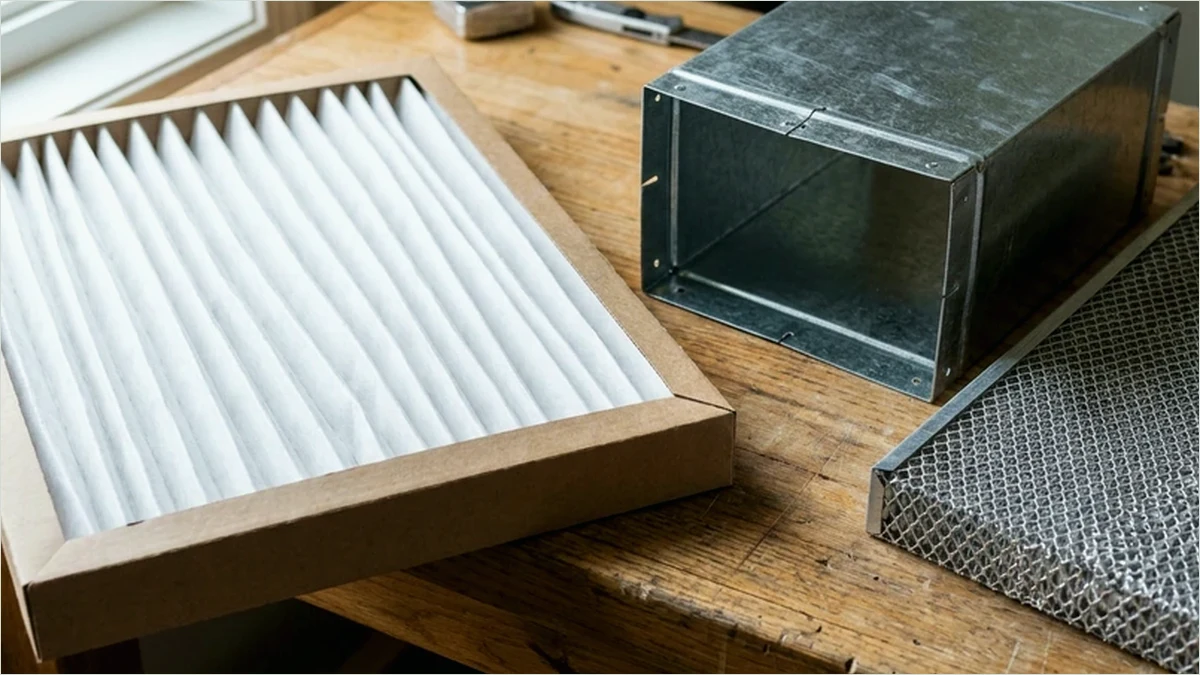
- Evaporative water panels in 120+ ppm hard-water regions lose 30 to 42 percent wicking surface area after 90 heating days.
- Expanded aluminum mesh with clay coating requires annual replacement even when bypass dampers remain closed during summer.
- Restricted bypass airflow raises return-to-supply pressure differential while starving downstream ductwork of moisture.
- Solenoid orifice clogging and drain line calcification accelerate when water panel scale flakes into the lower distribution tray.
Mineral Precipitation Mechanics on Clay-Coated Aluminum Mesh
Whole-house evaporative humidifiers rely on a porous clay-coated expanded aluminum matrix to maximize surface-area contact between warm supply air and metered potable water. Unlike ultrasonic or steam canister units that aerosolize or boil dissolved solids, flow-through bypass humidifiers flush excess water down a floor drain. However, continuous evaporation leaves behind calcium carbonate, magnesium sulfate, and trace silica inside the micro-pores of the clay coating. Once mineral crystallization bridges the 2.4 mm diamond apertures of the aluminum substrate, capillary wicking drops sharply and incoming water channels down narrow preferential paths instead of wetting the full panel width.
Archival service logs compiled by National Equipment Parts Archive since 2016 demonstrate a predictable relationship between municipal water hardness and effective panel lifespan. In regions measuring 3 to 5 grains per gallon (51 to 85 ppm), a standard Model 10 or Model 35 panel maintains 85 percent nominal evaporation capacity across a 150-day winter heating season. By contrast, Midwest and Mountain West installations drawing 14 to 22 grains per gallon (240 to 376 ppm) exhibit severe crusting along the bottom third of the frame within 60 days, cutting moisture output from 18 gallons per day down to roughly 10.5 gallons per day.
Measured Performance Across Common Water Panel Models
Selecting the correct OEM water panel geometry is critical because frame depth, width, and distribution tray engagement differ across bypass and fan-powered housings. Substituting a trimmed generic foam pad alters static pressure drop across the bypass duct and often causes water carryover into the furnace plenum. The comparison table below summarizes verified dimensional and flow specifications documented in our 2026 reference catalog.
| Panel Model | Nominal Dimensions (in) | Compatible Humidifier Series | Rated Output (GPD) | Recommended Service Cycle |
|---|---|---|---|---|
| Aprilaire No. 10 | 9.75 x 9.50 x 1.75 | Models 110, 220, 500, 550, 558 | 12.0 GPD | 12 months (6 months >180 ppm) |
| Aprilaire No. 12 | 11.50 x 14.75 x 1.75 | Models 112, 224, 440, 445 | 17.0 GPD | 12 months (6 months >180 ppm) |
| Aprilaire No. 35 | 10.00 x 13.00 x 1.75 | Models 350, 360, 560, 600, 700 | 18.0 GPD | 12 months (6 months >180 ppm) |
| Aprilaire No. 45 | 10.00 x 13.00 x 1.75 (Wicking) | Model 400 (Recirculating) | 17.0 GPD | 6 months (2 per heating season) |
Bypass Static Pressure and Fan-Powered Airflow Dynamics
In a bypass configuration such as the Model 500 or Model 600, air movement through the water panel depends entirely on the pressure differential between the supply plenum and the return trunk. Typical residential systems operate at 0.15 to 0.25 inches of water column (in. w.c.) across the bypass collar. As calcium deposits thicken on the upstream face of the water panel, free area shrinks and local resistance climbs above 0.32 in. w.c., reducing bypass cubic feet per minute (CFM) by 25 to 40 percent. Fan-powered units like the Model 700 use an internal 120V axial blower to pull air across the panel, which preserves airflow longer but forces the motor to run hotter when clogged mesh restricts intake volume.
Diagnostic Checklist for Annual Humidifier Servicing
Technicians auditing an evaporative humidifier before peak winter load should inspect downstream components alongside the media pad. Scale fragments frequently migrate into the 24VAC solenoid valve screen and the 1/2-inch condensate drain tubing.
- Verify 24VAC solenoid coil resistance (typically 18 to 26 ohms) and inspect the inline brass strainer screen for sediment.
- Confirm the upper distribution tray sits level on the water panel frame so metered water wets all vertical channels evenly.
- Measure supply-air temperature during heating cycles; air below 100 degrees Fahrenheit drops evaporation rates by up to 45 percent.
- Inspect the seasonal bypass damper blade position and verify the saddle valve or ball valve delivers 3.0 to 3.5 gallons per hour to the drain line.
An evaporative humidifier is a heat-and-mass transfer device first and a plumbing appliance second; if either airflow delta or clay-mesh wettability degrades, rated gallon-per-day figures become unattainable. -- National Equipment Parts Archive Technical Bulletin, 2026
Technical Frequently Asked Questions
Can an Aprilaire Model 35 water panel be washed and reused for a second winter?
No. The panel uses an expanded aluminum core coated with a porous clay-based wicking layer. Washing or scrubbing removes the clay coating and leaves hardened calcium inside the pores, which reduces water absorption and airflow.
Why does water run continuously down the drain when the humidifier is active?
Flow-through bypass humidifiers are engineered to flush a controlled stream of water down the drain to carry away dissolved minerals. A steady trickle of 3 to 3.5 gallons per hour during an active call for humidity is normal operation.
What is the physical difference between the Model 35 and Model 45 water panels?
Both measure 10 by 13 by 1.75 inches, but the Model 45 is engineered specifically for the Model 400 zero-drain unit and uses a dense fibrous wicking weave to draw standing water upward from a bottom reservoir.